
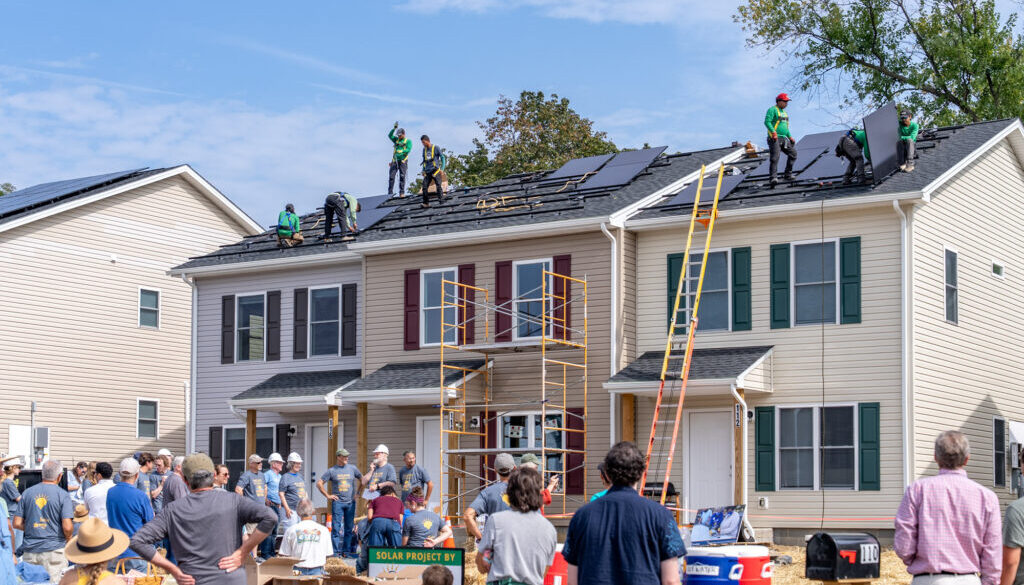
Habitat for Humanity National Solar Program with Jeff Heie
As electricity prices rise and housing costs strain family budgets, a new national effort aims to ensure affordable housing is also affordable to operate. The Habitat for Humanity National Solar Program, led by Jeff Heie of GiveSolar, plans to bring solar power to 10,000 Habitat homes across the U.S. and Puerto Rico in the next five years—cutting bills, building resilience, and expanding clean energy access.
For decades, Habitat for Humanity has helped families achieve the dream of homeownership. But in today’s economy, owning a home is only part of the equation. The real challenge is affording to live in it.
“Housing affordability isn’t just about the mortgage,” Jeff Heie told Earth Talks. “It’s about what it costs to operate the home over time.”
That insight is driving a bold new collaboration: pairing affordable housing with rooftop solar to reduce energy burdens for working families. What began as a small pilot in Virginia has grown into a national initiative with a $40 million fundraising goal—and a vision to transform how affordable housing is built in America.
Energy Burden Is a Hidden Housing Crisis
Many low-income households spend between 10% and 20% of their income on energy bills—an “energy burden” that experts consider unsustainable. Habitat families typically earn 80% or less of their area’s median income, and many fall closer to 60%.
Meanwhile, electricity prices have climbed sharply. Since 2020, U.S. residential electricity rates have risen by roughly 35%. For families already stretched by rising food, insurance, and housing costs, every dollar matters.
Housing affordability includes what it costs to operate the home. Jeff Heie
Solar offers a practical solution.
In Virginia, GiveSolar’s pilot projects installed systems averaging 12 panels per home (about 4.8 kilowatts of capacity). After a year of monitoring, the results were encouraging:
- Solar systems offset about 65% of annual electricity use.
- Families saved an average of $73 per month.
- Savings are projected to continue for 25–30 years.
The program’s national benchmark is ambitious: reduce homeowners’ electricity bills by at least 50%.
“If we can cut electricity bills in half, that changes lives.” — Jeff Heie
Practical Takeaways & Implications
- Affordable housing must include operating costs. A lower mortgage may not help if utility bills are overwhelming.
- Solar is financially viable today. The economics of solar clearly justify the up-front investment even for low-income households. Even modest systems can offset 50–65% of electricity use.
- Local partnerships unlock scale. Habitat’s national network allows rapid replication once funding and proof points are established.
- Flexible models expand access. Rooftop, ground-mounted, community, and plug-in solar options make adoption possible across varied regulatory environments.
- New donor audiences are emerging. Environmentally focused funders are supporting affordable housing through a climate lens.
For communities, Rotary clubs, nonprofits, and civic leaders, the message is clear: solar isn’t a luxury add-on. It’s a practical tool for economic justice and climate resilience.

From Local Pilot to National Movement
The effort began in Harrisonburg, Virginia, where Heie launched GiveSolar in 2018 to help nonprofits access solar energy. Many nonprofits can’t directly benefit from federal tax credits, limiting their ability to install solar systems.
Partnering with a local Habitat affiliate in 2020, Heie raised $10,000 for the first solar installation. Encouraged by community response, the team set a $100,000 goal—and surpassed it within months.
A pivotal moment came when the American Institute of Architects contacted GiveSolar while planning a major headquarters renovation in Washington DC. Seeking to offset the “embodied carbon” (the emissions created by producing building materials), the organization donated $500,000 to install solar on Habitat homes in Virginia.
That investment funded 78 solar installations which were completed by December of 2025.
Momentum continued. In September 2025, GiveSolar formally launched the national expansion, aiming to serve 10,000 Habitat families in five years.
If we can cut electricity bills in half, that changes lives. Jeff Heie
The program now works through Habitat’s statewide support organizations to aggregate projects and negotiate better pricing. By batching installations—10 to 20 homes at a time—costs can be reduced through economies of scale.
So far, $3.8 million has been raised to support early-stage programs in multiple states, including Kansas, Minnesota, Alabama, Wisconsin, and Puerto Rico.
Multiple Pathways to Solar Access
Not every home can accommodate rooftop panels. That’s why the national program uses a flexible toolkit:
Rooftop Solar:
The primary focus—ideal for new builds and unshaded roofs.
Ground-Mounted Solar:
Used when rooftops aren’t suitable, though lot size can limit options.
Plug-In (Balcony) Solar:
An emerging, lower-cost system that plugs directly into a household outlet—no complex permitting or interconnection required in some states.
Community Solar:
Families subscribe to a shared solar farm and receive bill credits, useful where rooftop installation isn’t viable or utility rules are restrictive.
In states with unstable grids, such as Puerto Rico, battery storage may also be considered to improve resilience. However, where net metering (a billing system that credits solar customers at the retail rate for excess energy sent to the grid) is available, batteries aren’t always necessary.
The guiding principle is simple: reduce bills in the most practical way available in each region.
Convincing a Decentralized Network
Habitat operates through more than 1,000 local affiliates in the U.S., each with its own leadership and board. Adding solar can feel like one more complexity in an already challenging housing landscape.
Construction costs, land prices, and labor shortages already strain affiliates. Adding a $15,000 solar system requires additional fundraising and coordination.
Heie understands the hesitation.
“Habitat has so many barriers to overcome when it comes to building affordable housing,” he acknowledged. “Adding solar can feel like one more box to check.”
The solution? Reduce the burden on affiliates by providing project management support through the national solar program.
Empowering working families with solar savings. Jeff Heie
The national program provides technical assistance, solar screening, fundraising support, and data tracking. Early adopters serve as demonstration sites and proof of concept, with performance data shared statewide to cultivate interest and build confidence.
Importantly, solar funding is largely sourced from environmentally focused donors—new supporters who may not have previously contributed to Habitat. That alignment reduces competition with core home-building fundraising.
A Broader Vision of Equity and Climate Action
At its heart, the National Solar Program is about empowerment.
Solar panels not only reduce monthly bills; they protect families from future rate hikes. Over two decades, electricity prices have risen an average of 3% annually—sometimes much more.
For families without generational wealth, predictability matters. A lower, stable energy bill provides breathing room for groceries, healthcare, education, and savings.
The initiative has also drawn endorsement from national organizations including the American Institute of Architects and the Solar Energy Industries Association. Supporters see the model as a blueprint for integrating climate solutions into mainstream housing policy.
Heie sums up the mission in one line:
“Empowering working families with solar savings.”
If successful, the program could redefine what affordable housing means—not just lower upfront costs, but long-term financial resilience.
And for thousands of families, that means a roof overhead powered by the sun.
About This Earth Talk
Speaker: Jeff Heie, Founder and Director of GiveSolar. Jeff leads a mission-driven nonprofit expanding solar access for low-income households through partnerships with Habitat for Humanity.
Date Presented: February 12, 2026
🎥 Watch on YouTube
🎧 Listen as a Podcast
🌱 Learn more: GiveSolar | Habitat for Humanity National Solar Program