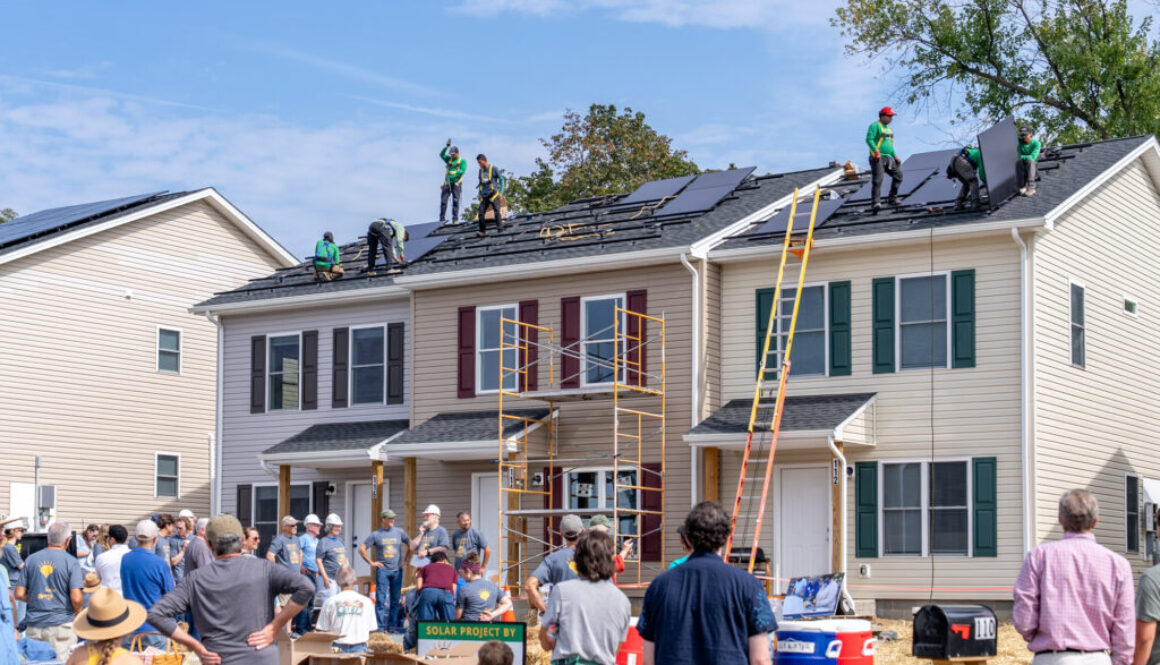
The program now works through Habitat’s statewide support organizations to aggregate projects and negotiate better pricing. By batching installations—10 to 20 homes at a time—costs can be reduced through economies of scale.
So far, $3.8 million has been raised to support early-stage programs in multiple states, including Kansas, Minnesota, Alabama, Wisconsin, and Puerto Rico.
Multiple Pathways to Solar Access
Not every home can accommodate rooftop panels. That’s why the national program uses a flexible toolkit:
Rooftop Solar:
The primary focus—ideal for new builds and unshaded roofs.
Ground-Mounted Solar:
Used when rooftops aren’t suitable, though lot size can limit options.
Plug-In (Balcony) Solar:
An emerging, lower-cost system that plugs directly into a household outlet—no complex permitting or interconnection required in some states.
Community Solar:
Families subscribe to a shared solar farm and receive bill credits, useful where rooftop installation isn’t viable or utility rules are restrictive.
In states with unstable grids, such as Puerto Rico, battery storage may also be considered to improve resilience. However, where net metering (a billing system that credits solar customers at the retail rate for excess energy sent to the grid) is available, batteries aren’t always necessary.
The guiding principle is simple: reduce bills in the most practical way available in each region.
Convincing a Decentralized Network
Habitat operates through more than 1,000 local affiliates in the U.S., each with its own leadership and board. Adding solar can feel like one more complexity in an already challenging housing landscape.
Construction costs, land prices, and labor shortages already strain affiliates. Adding a $15,000 solar system requires additional fundraising and coordination.
Heie understands the hesitation.
“Habitat has so many barriers to overcome when it comes to building affordable housing,” he acknowledged. “Adding solar can feel like one more box to check.”
The solution? Reduce the burden on affiliates by providing project management support through the national solar program.









 Watch on
  Listen as a
  Read the