
The Heat We Don’t See: Cooling Our Buildings & Cities with Neetu Jain
As cities face rising temperatures, climate-tech entrepreneur Neetu Jain is showing how reflective roofs, smarter building materials, and practical cooling solutions can protect people, conserve energy, and make urban communities more resilient.
On a scorching summer afternoon in India, a concrete rooftop can reach 158°F (70°C), while a metal roof may climb to 176°F (80°C). Long after sunset, those surfaces can continue releasing stored heat, keeping homes, workplaces, and entire neighborhoods uncomfortably warm.
For Neetu Jain, founder and managing director of Panache Greentech Solutions, this overlooked heat is both an environmental challenge and an opportunity for change.
Known as the “Cool Roof Lady of India,” Jain has spent nearly two decades developing ways to prevent buildings from absorbing excessive solar heat in the first place.
During an October 8, 2026, Earth Talks presentation, she explained how reflective coatings, thermal insulation, and thoughtful building design can reduce cooling demands while improving everyday life.
Her message was encouraging: creating cooler, healthier cities does not always require complicated technology. Sometimes, it begins with rethinking the surfaces already surrounding us.
The Big Picture
- Why Our Buildings Are Making Cities Hotter
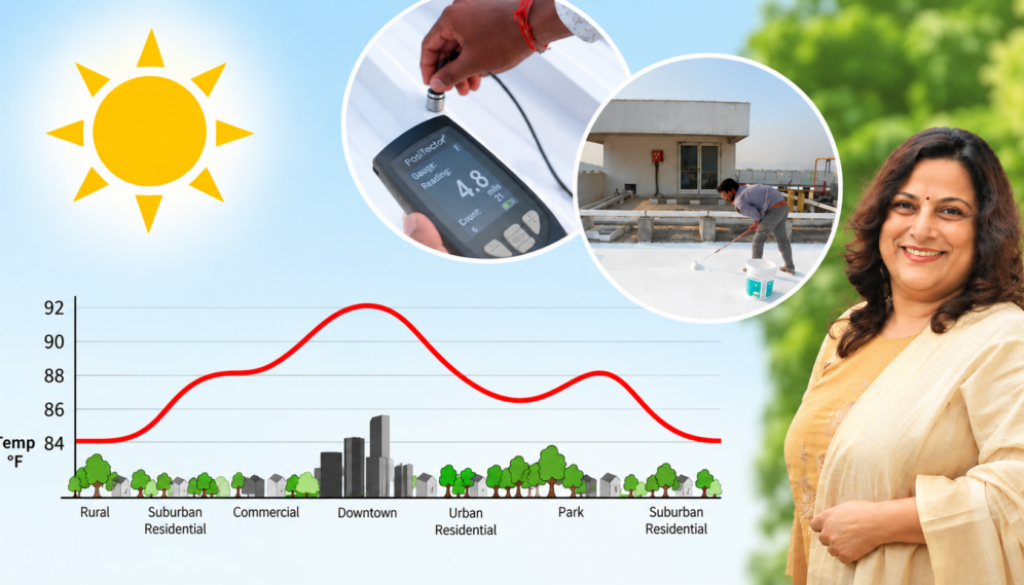
Cities contain enormous amounts of concrete, asphalt, metal, and glass. These materials absorb solar energy throughout the day, raising surface temperatures well above the surrounding air temperature.
As buildings release stored heat, particularly after sunset, they contribute to the urban heat island effect, which occurs when developed areas remain warmer than nearby rural surroundings.
Key Takeaways
- Urban buildings absorb and release solar heat, making cities hotter, even after sunset.
- Reflective cool roofs can reduce indoor temperatures and lower air-conditioning demand.
- Effective cooling combines reflective surfaces, insulation, ventilation, waterproofing, and thoughtful design.
- Cool-roof technology can complement solar panels and help improve building energy performance.
- Schools, affordable housing, and community buildings offer valuable opportunities for practical heat-resilience projects.

Closely spaced buildings can intensify the problem by restricting airflow and trapping warmth between structures. Air conditioners provide indoor relief but also release waste heat outdoors, adding to neighborhood temperatures.
Jain emphasized that urban heat is not simply a matter of uncomfortable weather. It affects electricity costs, public health, and economic productivity. Outdoor workers may lose working hours, families may struggle with sleep, and people without reliable cooling face greater exposure to heat-related illness.
Understanding how buildings absorb and release heat is an important first step toward addressing these challenges.
- From a Family Rooftop to a Mission for Cooler Cities
Jain’s journey began in 2008, influenced by conversations with her father, an innovator, while living in Rajasthan, one of India’s hottest regions.
Initially seeking an additional source of income, she began working with a product designed to keep rooftops cooler while protecting them from water penetration.
What began as a business opportunity gradually became a larger environmental mission.
Reflecting on her experience at an international energy-efficiency gathering in the United States, Jain explained, “I realized that what I was doing only for my source of income, it has such a great potential and this is such a great purpose that I can work on.”
The gathering helped her recognize that widespread adoption of cool roofs could contribute to lowering urban temperatures, not merely improving individual buildings.
“This is such a great purpose that I can work on.” Neetu Jain
That realization shaped her vision of cooler, greener cities and inspired her to expand beyond a single product into integrated building solutions. Today, her work connects technology, industry partnerships, education, and public policy, demonstrating how an entrepreneurial idea can evolve into a broader contribution to climate resilience.
- Cool Roofs: A Simple Technology with Significant Potential
Cool roofs work by reflecting more sunlight and releasing absorbed heat efficiently, rather than allowing it to accumulate in building materials.
Specialized coatings are designed to reflect solar radiation, including near-infrared energy that contributes to surface heating. Their performance is often measured using the Solar Reflectance Index (SRI), which combines reflectivity and heat-release characteristics.
Jain described the concept in familiar terms: “So it works like an umbrella when we walk and we take the umbrella.” The technology essentially provides a protective layer that reduces how much solar energy a roof absorbs.
According to performance figures Jain presented, suitable reflective roof systems have achieved surface temperature reductions of approximately 36–45°F (20–25°C) and indoor temperature reductions of 7–14°F (4–8°C) under certain Indian conditions.
“It works like an umbrella.” Neetu Jain
She also reported potential cooling-energy savings of 20–30%, although actual results depend on climate, building design, installation quality, and cooling equipment.
Importantly, she cautioned that ordinary white paint is not necessarily equivalent to a tested cool-roof coating. Effective systems must maintain solar reflectivity while resisting moisture, dirt, weathering, and surface deterioration.
- Combining Cooling Technology with Renewable Energy
Cooler buildings can also complement other sustainability investments, particularly rooftop solar panels. During the Earth Talks discussion, participants asked whether reflective roofing could improve solar electricity generation.
Jain explained that solar panels generally perform better when excessive heat is reduced. Reflective rooftops may also provide additional light to bifacial panels, which generate electricity from both sides.
Discussing the importance of appropriate operating temperatures, she observed, “Solar panel works better if the optimum temperature is there.”
Her presentation described project results suggesting increased solar output when reflective roofing and photovoltaic systems were combined. These were project-specific findings rather than guaranteed performance improvements.
The discussion also explored rooftop vegetation, traditional building techniques, and the importance of waterproofing. Jain emphasized that different cooling strategies can work together, provided the building’s needs and intended outcomes are carefully evaluated.
The larger opportunity is to approach buildings as connected systems, combining reflective surfaces, ventilation, insulation, waterproofing, and renewable energy where appropriate.
Jain described installations at schools, industrial facilities, and commercial buildings, including a project involving approximately 25 schools in Warangal, India, that helped inform subsequent cool-roof policy development.
For Rotary clubs and nonprofit organizations, similar projects could begin with a school, community center, or neighborhood building. A carefully monitored pilot can help demonstrate results, build partnerships, and support broader adoption.
Reflective roofs are not a substitute for reducing greenhouse gas emissions or expanding urban green spaces. They are one practical tool within a larger climate-resilience strategy.
The most important shift may be conceptual: instead of relying only on mechanical cooling after buildings become hot, communities can design buildings to absorb less heat from the beginning.
A cooler roof can mean a more comfortable classroom, a safer workplace, a lower electricity bill, and a neighborhood better prepared for extreme temperatures.
Practical Takeaways & Implications
Jain’s presentation offers practical lessons for homeowners, schools, businesses, city planners, and community organizations.
- Start with the roof. Evaluate how much sunlight the building absorbs and whether a certified reflective coating could reduce heat gain.
- Choose tested materials. Compare solar reflectance, thermal performance, durability, and maintenance requirements rather than relying on color alone.
- Consider the entire building. Combine suitable roofing with ventilation, insulation, shade, and waterproofing for more reliable results.
- Prioritize vulnerable communities. Schools, affordable housing, and buildings occupied by people without air conditioning can be important candidates for heat-reduction projects.
- Measure the benefits. Track indoor temperatures, electricity consumption, occupant comfort, and maintenance costs before and after improvements.
About This Earth Talk
Speaker: Neetu Jain is the founder and managing director of Panache Greentech Solutions and a climate-tech entrepreneur known as the “Cool Roof Lady of India.” She advocates for cooler, greener, and more resilient cities through reflective roofing, thermal insulation, waterproofing, and urban heat mitigation. She is also a Rotary leader and has participated in international energy-efficiency initiatives.
Presented: October 8, 2026
🎥 Watch on YouTube: Link
🎧 Listen as a Podcast: Link
📖 Read the Blog: Link