
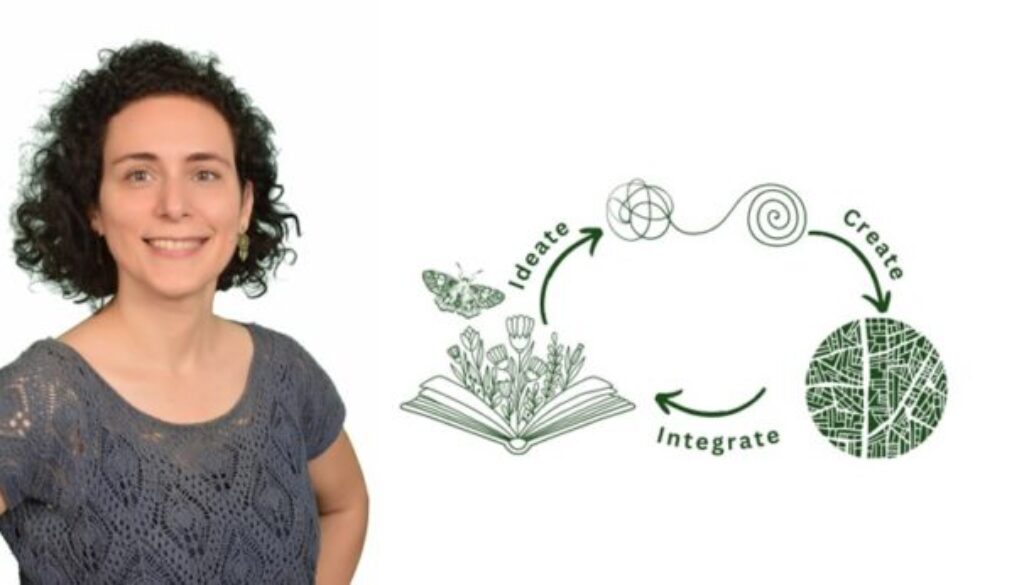
Nature: From Cells to Systems with Joanna Jurdi 12 March 2026
From the smallest cell to entire ecosystems, nature has refined systems that sustain life for billions of years. Biomimicry invites us to learn from those systems—and design our human world to thrive within them.
Introduction
What if the solutions to many of humanity’s biggest challenges—climate change, resource scarcity, and sustainable development—were already tested and perfected over billions of years?
According to architect and biomimicry expert Joanna Jurdi, nature offers exactly that kind of blueprint. Life on Earth has been evolving for roughly 4.8 billion years, developing complex systems that cooperate, adapt, and regenerate. Humans, by contrast, have existed for only about 300,000 years—a tiny fraction of that timeline. Yet the systems we’ve built often ignore the ecological wisdom embedded in natural systems.
Key Insights
Learning From Life’s Deep History
The story of life begins with the simplest unit: the cell. Early life forms evolved from basic prokaryotic cells into complex eukaryotic cells through cooperation among microorganisms. Evolutionary biologist Lynn Margulis demonstrated that many parts of modern cells—such as mitochondria—originated as separate bacteria that joined together in mutually beneficial partnerships.
For Jurdi, this ancient biological story contains a powerful lesson.
“Life evolved through cooperation,” she explains. “Different organisms came together, organized themselves, and created something more complex and resilient.”
“Life evolved through cooperation. Different organisms working together created the complexity we see today.” Joanna Jurdi
That principle echoes throughout nature—from microbial communities to forests—and offers a model for human systems as well. Instead of competition and fragmentation, nature relies on interdependence and shared function.
Biomimicry: Beyond Efficiency
The concept of biomimicry literally means “imitating life.” But Jurdi emphasizes that the field goes far deeper than borrowing shapes from plants or animals.
Biomimicry has three key dimensions:
- Ethos – Respect for life and the goal of creating conditions that support living systems
- Reconnect – Recognizing that humans are part of nature, not separate from it
- Emulate – Applying nature’s strategies in design, technology, and governance
“Biomimicry is the conscious emulation of nature’s genius.”
Key Takeaways
- Nature’s 4.8 billion years of evolution provide tested strategies for resilient design.
- Biomimicry studies nature’s forms, processes, and ecosystems to guide human innovation.
- Healthy ecosystems rely on cooperation, diversity, and circular resource flows.
- Nature-inspired design can reduce energy use, improve water systems, and strengthen agriculture.
- Rotary clubs can apply biomimicry principles to strengthen collaboration and community impact.
- Complete Joanna Jurdi’s Biomimicry for Rotary questionnaire to reflect on your club’s systems. Email Programs@earthnetworkrotary.org for results.

Early forms of biomimetics focused on engineering—designing faster machines or stronger materials. Biomimicry, by contrast, seeks to align human innovation with nature’s deeper principles: circularity, cooperation, and resilience.
Designing Buildings Like Leaves
One example from Jurdi’s own architectural work illustrates how nature-inspired design can transform buildings.
While working on a residential project in Nigeria, her team studied tropical plant leaves. These leaves have waxy surfaces and curved shapes that allow them to shed heavy rainfall while managing heat and wind.
Inspired by this structure, the design incorporated:
- Natural ventilation corridors
- Shaded microclimates within the building
- Green spaces that cool the surrounding air
The result was a building that requires far less artificial cooling, demonstrating how architecture can adapt to local climate rather than fight it.
Jurdi calls this principle the “genius of place”—designing in harmony with local environmental conditions.
Nature’s Water Innovations
Nature also provides remarkable solutions to water scarcity.
In the Namib Desert, a plant called Welwitschia mirabilis gathers moisture from fog and dew. Its leaves channel condensed water into the plant’s core, allowing it to survive in extremely dry environments.
By studying this process, engineers can design more efficient dew-harvesting systems for arid regions
“Biomimicry is the conscious emulation of nature’s genius.” Joanna Jurdi
Similarly, mangrove trees thrive in salty coastal waters by filtering salt through specialized root systems. Their natural desalination mechanisms could inspire future technologies that make freshwater production more energy-efficient.
“These organisms show incredible ingenuity,” Jurdi explains. “Nature has already solved many of the problems we face.”
The Power of Ecosystems
Perhaps the most profound lessons come from ecosystems themselves.
In a healthy forest, countless species work together in complex relationships. Pine trees create shade and microclimates. Oak trees enrich the soil with nitrogen. Herbs like rosemary attract pollinators that support the entire plant community.
No species exists alone. Every organism contributes to the system’s health.
Jurdi describes this as symbiosis—a defining feature of living systems. Beneath the soil, fungi networks connect plant roots in what scientists sometimes call the “wood-wide web.” Through these networks, plants share nutrients and even send warning signals about pests or drought.
The result is a resilient system where diversity strengthens survival.
“Nature never works as isolated parts,” Jurdi says. “Everything is connected.”
Circular Systems: Waste Becomes Food
One of nature’s most important lessons is that waste doesn’t exist.
Every output from one organism becomes a resource for another. Dead leaves feed soil microbes. Animal waste fertilizes plants. Nutrients cycle continuously through ecosystems.
Jurdi applied this principle to a farming project in Nigeria.
The farm integrates several interconnected components:
- Fish ponds producing natural fertilizer
- Water circulating through crops for irrigation
- Azolla plants used as livestock feed
- Organic waste converted into compost
Each element supports another, creating a closed-loop agricultural system that requires little external input.
Practical Takeaways & Implications
Biomimicry offers more than design inspiration—it offers a framework for rethinking how organizations, communities, and institutions function.
Instead of focusing only on reducing harm, biomimicry encourages leaders to design systems that actively create conditions conducive to life. That means understanding relationships, flows, and feedback loops in the same way ecosystems do.
For Rotary clubs, districts, and community organizations, this systems-thinking approach can help strengthen collaboration, resilience, and impact.
“In nature there is no waste—every output becomes a resource for another organism.” Joanna Jurdi
To support this reflection, Joanna Jurdi has created a short assessment tool titled Biomimicry for Rotary. The questionnaire invites Rotary clubs, districts, and teams to reflect on how closely their structures and practices mirror the principles of healthy living systems.
The purpose of the questionnaire is to serve as a reflective tool that helps bring clarity to how a Rotary club, community, or team functions. Using biomimicry methodology, it encourages participants to consider how cooperation, diversity, feedback, and circular thinking might inspire positive change in their own environments.
Rotary clubs and districts are invited to complete the form and explore how nature’s principles might strengthen their programs and partnerships.
Complete the Biomimicry for Rotary questionnaire.
For questions or to share insights from your club’s experience, contact: Programs@earthnetworkrotary.org
By learning from nature’s patterns—from cells to ecosystems—communities can discover new ways to collaborate, innovate, and regenerate the systems that support life.
About This Earth Talk
Speaker: Joanna Jurdi
Architect and biomimicry specialist with an MS in Biomimicry from Arizona State University. With over 15 years of experience in sustainable architecture, she focuses on designing regenerative systems that create conditions conducive to life.
Date Presented: March 12, 2026
🎥 Watch on YouTube
🎧 Listen as a Podcast
📖 Read the Blog
🌱 Complete Biomimicry for Rotary


