Adopt-a-Village, Lasting Impact with Dinesh Raj Manandhar
What if one village could become a model for healthier communities, stronger livelihoods, and environmental resilience? Dr. Dinesh Raj Manandhar explains how integrating Rotary’s Seven Areas of Focus can turn individual projects into lasting community transformation.
A clean water system can transform daily life. A school can open doors to opportunity. Solar power can support livelihoods, while healthier ecosystems can strengthen a community’s resilience.
But what happens when these improvements are planned together rather than delivered as separate projects?
During the 5 November 2026 Earth Talks presentation, Adopt-a-Village, Lasting Impact, Dr. Dinesh Raj Manandhar introduced a practical model for bringing Rotary’s Seven Areas of Focus together within one community.
Drawing on more than 35 years of experience in water, sanitation, hygiene, and community development, Manandhar described a participatory approach that combines infrastructure, education, health, environmental protection, and economic opportunity.
His central message was compelling: sustainable development requires more than completing projects. It requires building connected systems that communities can manage, maintain, and expand.
Key Takeaways
- Integrating Rotary’s Seven Areas of Focus creates opportunities for more connected, sustainable community development.
- Community needs assessments and local leadership should guide every stage of an Adopt-a-Village program.
- Multi-year commitments help communities build the skills and resources needed to sustain improvements.
- Consider climate resilience when planning water, energy, infrastructure, and environmental projects.
- Collaboration among Rotary clubs, Rotary Action Groups, and local partners can expand long-term impact.
From Individual Projects to Connected Communities
Traditional development projects often concentrate on a single need, such as installing a water system, improving a school, or providing healthcare.
Manandhar’s Adopt-a-Village model recognizes that these needs are interconnected.
Reliable water and sanitation can improve health and reduce time spent collecting water. Better health can support school attendance and productivity. Education and vocational training can create economic opportunities, while environmental restoration helps protect the natural resources communities depend on.
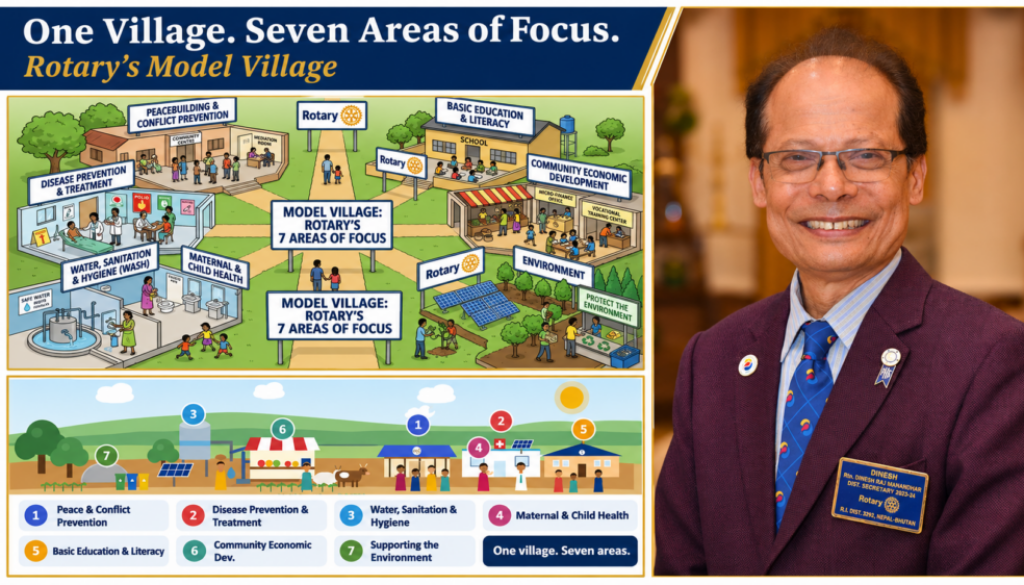
The model brings together Rotary’s Seven Areas of Focus: peacebuilding and conflict prevention; disease prevention and treatment; water, sanitation and hygiene; maternal and child health; basic education and literacy; community economic development; and supporting the environment.
Rather than treating these as separate priorities, the approach integrates them within a defined geographic area.
Clean water often provides a starting point, but lasting success depends on strengthening the entire community system. Livelihoods, local financing, maintenance capacity, and environmental resilience help ensure that initial investments continue delivering benefits.
Community Ownership Is the Foundation
For Manandhar, the most important element is not infrastructure. It is participation.
He explained that adopting a village requires a collaborative process shaped by the people who live there.
As he emphasized, “It’s not a top-down … it’s a bottom-up approach.”
That principle begins with a community needs assessment. Before selecting projects, partners must understand local priorities, existing resources, economic conditions, and environmental challenges.
A village experiencing water scarcity may prioritize drinking water and groundwater recharge. Another may need reliable electricity, improved sanitation, or agricultural support.
The appropriate starting point depends on the community.
Local residents also need meaningful roles in planning, monitoring, and maintaining improvements. Manandhar highlighted Rotary Community Corps, groups of non-Rotarian community members who help organize local participation and support projects over time.
These groups can include women, young people, and other community representatives, ensuring that decisions reflect a wider range of experiences and priorities.
“It’s not a top-down ... it’s a bottom-up approach.” Dr. Dinesh Raj Manandhar
Community ownership changes the relationship between external partners and residents. Rather than simply receiving assistance, local people help set priorities, build skills, and take responsibility for sustaining results.
Building a Sustainable Village Over Time
Adopting a village is not a short-term intervention. Manandhar proposed a three-to-five-year commitment, with a conceptual four-phase implementation framework.
The first phase focuses on assessment and engagement, including establishing baseline conditions and organizing community participation.
The second phase develops essential infrastructure, potentially including water and sanitation systems, schools, healthcare facilities, or solar energy installations.
The third phase strengthens skills and livelihoods through vocational training, agricultural improvements, and economic opportunities.
The final phase emphasizes operations, maintenance, monitoring, and the transfer of responsibilities to local organizations.
Manandhar also described a pass-on approach in which households receiving livestock, seeds, or other productive resources help extend similar benefits to additional households.
This allows investments to reach beyond their initial beneficiaries.
The model also recognizes that infrastructure alone does not guarantee sustainability. Water systems need trained operators, replacement parts, and financing. Schools need teachers and ongoing support. Agricultural initiatives need access to markets.
Measuring results throughout implementation helps communities and partners understand what is working and where adjustments are needed.
Climate Resilience and Collaboration Strengthen the Model
Environmental protection is not an optional addition to community development. It is essential to protecting progress.
Discussing climate-related risks, particularly flooding in Nepal, Manandhar emphasized that development investments must account for changing environmental conditions.
His presentation highlighted the importance of climate-resilient infrastructure, solar-powered pumping, rainwater harvesting, groundwater recharge, biodiversity protection, and improved waste management.
He also stressed that projects must reflect local conditions rather than follow a universal formula.
“Every community is different, right?” he reminded participants when discussing the importance of needs assessments.
That observation has practical consequences. Infrastructure that works in one village may be unsuitable in another because of differences in geography, water availability, climate exposure, or economic capacity.
“Every community is different, right?” Dr. Dinesh Raj Manandhar
Collaboration can help communities address these challenges. Rotary clubs, districts, action groups, local governments, and private-sector partners can contribute different forms of expertise and funding.
During the discussion, participants explored opportunities to connect international Rotary networks and integrate renewable energy into village development, including in communities without grid electricity.
The goal is not to impose the same sequence everywhere, but to coordinate resources around locally identified priorities.
Practical Takeaways & Implications
Manandhar’s presentation offers a practical framework for Rotary clubs, nonprofit organizations, and community leaders seeking to move from isolated projects toward long-term impact.
Start by listening. Conduct a participatory needs assessment before deciding which interventions to fund. Identify community priorities, existing capabilities, and the environmental conditions that could influence success.
Think in connected systems. Consider how water, energy, education, health, livelihoods, and environmental protection reinforce one another. A coordinated program may create benefits that individual projects cannot achieve alone.
Commit beyond the installation. Plan for several years of engagement, including training, maintenance, local financing, and measurable outcomes. A completed facility is only the beginning of sustainable service delivery.
Build local leadership. Establish representative community structures that can participate in decisions, monitor progress, and eventually manage essential services.
Design for resilience. Evaluate climate risks and choose appropriate technologies, infrastructure, and maintenance strategies.
Collaborate across disciplines. Rotary’s clubs, districts, and action groups offer opportunities to combine expertise in water, renewable energy, health, education, and environmental protection.
The Adopt a Village concept is ultimately about creating conditions in which communities can sustain their own progress.
One village may begin with clean water. Another may begin with electricity, education, or economic opportunity. What matters is connecting these investments into a shared, locally led vision.
When small actions reinforce one another, their benefits can extend across households, generations, and communities.
Small Actions. Big Ripples. One Earth.
About This Earth Talk
Speaker: Dr. Dinesh Raj Manandhar is a water, sanitation, and hygiene (WASH) researcher and consultant with more than 35 years of national and international experience. He serves as an ESRAG Global Board Director (2025–2028), Rotary International Environment Cadre Technical Coordinator, and Rotary leader in District 3292, Nepal and Bhutan.
Presented: 5 November 2026
🎥 Watch on YouTube: Link
🎧 Listen as a Podcast: Link
📖 Read the Blog: Link