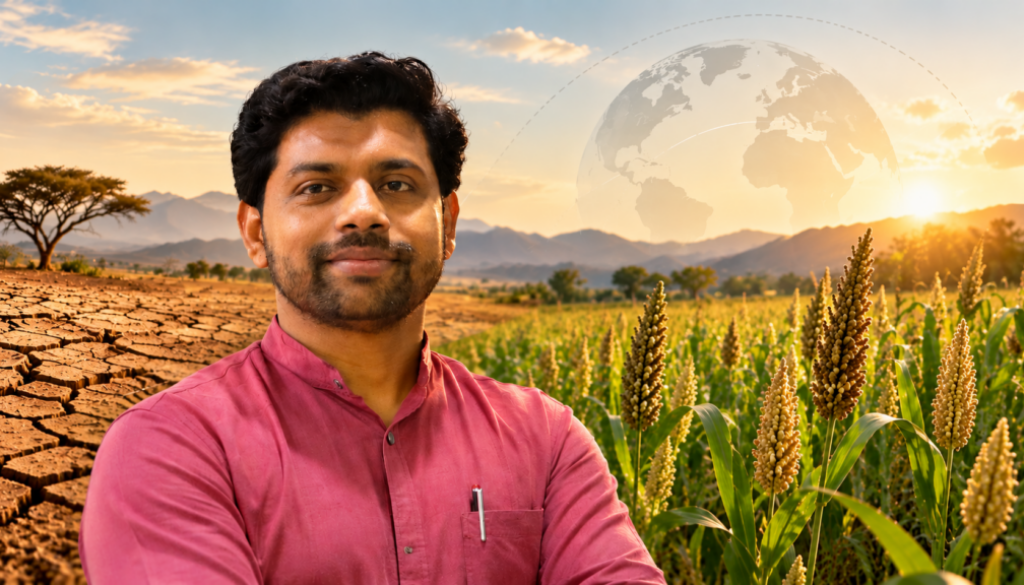
From Drylands to Dining Tables: Rethinking Food for a Changing Climate with Dr. Veeresh S. Wali
What if some of the foods that help us adapt to a changing climate are crops we have grown for generations? Agricultural economist Dr. Veeresh S. Wali explores how climate-resilient grains, food innovation, and stronger markets can nourish people, support farmers, and protect the planet.
As climate change reshapes agriculture, the future of food may depend as much on rediscovering traditional crops as developing new technologies.
Across the world, farmers are confronting unpredictable rainfall, rising temperatures, water scarcity, and uncertain incomes. Meanwhile, consumers need food that is nutritious, affordable, accessible, and enjoyable.
During an Earth Talks presentation on October 22, 2026, Dr. Veeresh S. Wali, an agricultural economist and global food systems specialist from India, explored how these challenges are connected and why solutions must extend beyond the farm.
His presentation, From Drylands to Dining Tables: Rethinking Food for a Changing Climate, highlighted millets, traditional grains with valuable climate-adaptation potential, as an example of how agricultural knowledge, entrepreneurship, consumer preferences, and supportive policies can work together.
His central message was clear: resilient food systems must serve people, the planet, and the economy.
Key Takeaways
- Climate-resilient food systems must address human nutrition, environmental sustainability, and farmer livelihoods together.
- Traditional grains such as millets offer opportunities to diversify agriculture in water-stressed regions.
- Taste, affordability, convenience, and availability are essential for sustainable foods to reach consumers.
- Processing, entrepreneurship, and market development can create greater economic opportunities for farmers.
- Supportive policies and collaboration can help turn climate-smart agricultural ideas into lasting change.

Why Our Food Systems Need to Change
Food systems face three interconnected challenges.
The first is human well-being. Hunger, micronutrient deficiencies, obesity, and diet-related illnesses coexist in communities around the world.
The second is environmental pressure. Water scarcity, soil degradation, biodiversity loss, and climate change threaten agricultural productivity.
The third is economic instability. Farmers face uncertain incomes, fluctuating prices, supply disruptions, and changing market conditions.
Wali emphasized that solutions cannot address these problems independently. A crop that conserves water but provides no reliable income may struggle to attract farmers. A nutritious food that consumers cannot afford or prepare conveniently may never achieve widespread adoption.
Building resilience therefore requires considering the entire journey from agricultural production to processing, distribution, and consumption.
Rediscovering Millets: Ancient Grains for a Changing Climate
Millets offer an important example of how traditional agriculture can contribute to modern food security.
These grains, including pearl millet, finger millet, and other varieties, have long been cultivated in parts of Asia and Africa. Many are adapted to dryland conditions and can perform well where water availability is limited.
Wali explained that climate resilience should become a central consideration when selecting and promoting crops. In particular, he emphasized the importance of agricultural diversification rather than relying excessively on a narrow range of staples.
India provides a compelling case study. Following decades in which rice and wheat dominated agricultural priorities, renewed attention to millets has encouraged research, product development, entrepreneurship, and policy support.
However, simply encouraging farmers to grow different crops is not enough.
Farmers need dependable markets, and consumers need compelling reasons to purchase the resulting products. That requires coordinated action across the food system.
Making Climate-Friendly Food Desirable
For climate-resilient foods to become part of everyday diets, environmental benefits alone are unlikely to persuade consumers.
As Wali observed, “Taste is something that’s very crucial for any food item.” He identified taste, affordability, convenience, familiarity, nutrition, and availability as essential factors influencing food choices.
This insight helps explain why millet innovation has expanded beyond traditional grain preparations.
Entrepreneurs are developing millet-based cookies, muffins, breakfast cereals, beverages, burgers, and even ice cream. These products demonstrate how traditional ingredients can be adapted to contemporary eating habits.
“Taste is something that's very crucial for any food item.” Dr. Veeresh S. Wali
Innovation also helps overcome practical barriers. Busy households may appreciate foods that require little preparation, while younger consumers may be more willing to try familiar products made with alternative grains.
The lesson extends beyond millets: sustainable food choices must fit people’s lives. Making climate-friendly food delicious, convenient, and accessible can turn good intentions into lasting habits.
From Farm Production to Thriving Food Businesses
Growing climate-resilient crops is only the beginning. Farmers also need access to processing facilities, reliable supply chains, business opportunities, and customers.
Wali described the importance of what he called the missing middle, the processing and value-adding activities that connect agricultural production with consumer markets.
Drawing on his experience supporting millet entrepreneurs through Nutrihub at the ICAR–Indian Institute of Millets Research, he explained how innovation can transform traditional crops into commercially viable products.
He also stressed the importance of supportive public policy, “Policy has an equal importance as production at the farm level has.” This means food-system transformation cannot depend on individual farmers alone.
Governments, research institutions, businesses, and community organizations all have roles in developing infrastructure, supporting entrepreneurship, expanding markets, and creating incentives for sustainable agriculture.
“Policy has an equal importance, like production at the farm level has.” Dr. Veeresh S. Wali
During the audience discussion, Wali reinforced this point by advocating market creation rather than expecting farmers to change crops without economic incentives.
He recommended building demand through innovation, technology, awareness, and policy so farmers have compelling reasons to participate.
Practical Takeaways & Implications: Small Actions, Stronger Food Systems
Wali’s presentation offered a practical framework for creating food systems that are more adaptable, inclusive, and sustainable.
For individuals and families, the first step can be simple: explore traditional grains and diversify everyday meals. Trying millet-based dishes or other locally appropriate climate-resilient foods can help broaden food choices and encourage demand.
For educators and community organizations, food literacy offers another opportunity. Cooking demonstrations, discussions about sustainable agriculture, and partnerships with local food entrepreneurs can connect climate awareness with daily decisions.
For farmers and agricultural businesses, crop diversification should be paired with attention to profitability, processing, and market access. Climate adaptation becomes more achievable when environmentally appropriate practices also support livelihoods.
For policymakers and development organizations, investment in research, infrastructure, entrepreneurship, and reliable markets can help bridge the gap between agricultural potential and widespread adoption.
Importantly, millets are not a universal solution. Different regions require approaches suited to their climates, food cultures, and economic circumstances.
The broader lesson is that resilience grows through collaboration.
When traditional agricultural knowledge meets modern innovation, supportive policies, and consumer participation, communities can build food systems that are better prepared for an uncertain climate.
From drylands to dining tables, meaningful change begins with connecting the choices we make today to the food systems we want tomorrow.
Small Actions. Big Ripples. One Earth.
About This Earth Talk
Speaker: Dr. Veeresh S. Wali is an agricultural economist and global food systems specialist with experience in value chains, entrepreneurship, incubation, and agricultural policy across Asia, the Middle East, and Africa. His work includes supporting millet-based startups, contributing to India’s International Year of Millets 2023 initiatives, and strengthening connections between agricultural innovation, markets, and sustainable food systems.
Presented: October 22, 2026
🎥 Watch on YouTube: Link
🎧 Listen as a Podcast: Link
📖 Read the Blog: Link
🌱 Learn more: Connect with Dr. Veeresh S. Wali on LinkedIn